Passover 2026
Seder, Remixed
The Maggid as 13 different shows
The Maggid is the storytelling heart of the Seder — and the part where kids (and adults) tend to drift. So I rebuilt every section as a different format, gave everyone at the table a character, and printed real scripts for a cast aged 2 to 80.
The Idea
Every section, a different show
- 1Ha Lachma AnyaThe Pregame Speech
- 2Mah NishtanaThe Song, Then the Press Conference
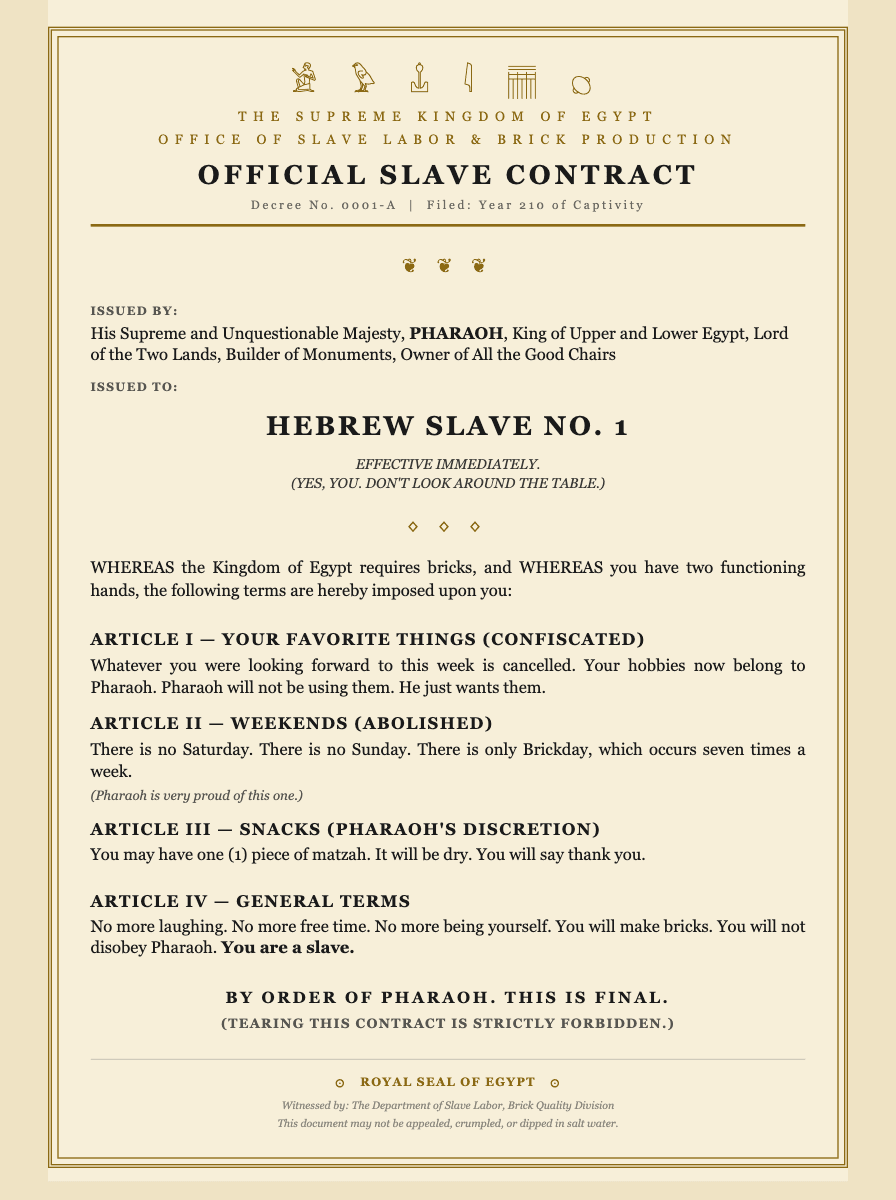
- 3Avadim HayinuPharaoh Takes Over + The Slave Contracts
- 4Five Rabbis in Bnei BrakThe Challenge
- 5The Four SonsAll Four Live in You
- 6Yechol Me'Rosh ChodeshWhy Tonight?
- 7V'hi She'amdaThe Prequel + The Anthem
- 8Arami Oved AviThe Movie
- 9The Ten PlaguesThe Plague Show
- 10DayenuOur Own Dayenu
- 11Rabban GamlielShow and Tell, In Character
- 12HallelThe Victory Lap
- 13Second CupThe Victory Toast
How I Built It
From ancient text to printed script
Pull the source texts
Hebrew and English for every Maggid section, pulled from Sefaria so the script stays anchored to the real text.
Outline before writing
A creative outline matching each section to a format and each person to a character — before a single line of dialogue.
Write the script with Claude Code
A 1,400-line run-of-show in plain Markdown: dialogue, stage directions, Hebrew blocks, timing for every part.
Print it with Python
A script turns the Markdown into Letter-size PDFs — a color for every character, right-to-left Hebrew, each section on a fresh page.
The Clever Bit
Two scripts, same page numbers
The kids needed their own version — one that didn’t spoil the surprises or print the answers to the quiz questions. But a Seder runs on “everyone turn to page 12.” So wherever the kids’ script cuts something, the generator drops in an invisible spacer the same height as the missing content. Every section lands on the same page in both versions.
Adult script
Kids script
The Hit
The slave contracts
Midway through, Pharaoh takes over the table and hands everyone a sealed envelope: a personalized “Official Slave Contract” confiscating the things they love most. Then comes the liberation moment — and everyone rips theirs up. It was the moment of the night. (Shown here: a blank demo contract.)
What I'd Change
Flip the ratio
The theater landed at the start and the end. By the middle, it got old. The script moved from moment to moment without leaving room for real questions, tangents, or the notes the kids brought themselves — and the best Seder moments are the unscripted ones. This year was roughly 75% performance, 25% conversation. Next year flips it, in three acts:
Open
Performance. High-energy, immersive — Pharaoh, contracts, the works.
Middle
Conversation. Prepare topics and sources, not scripts. Kids bring their own material.
Close
Performance. Plagues, Dayenu, and the victory lap bring the energy back.